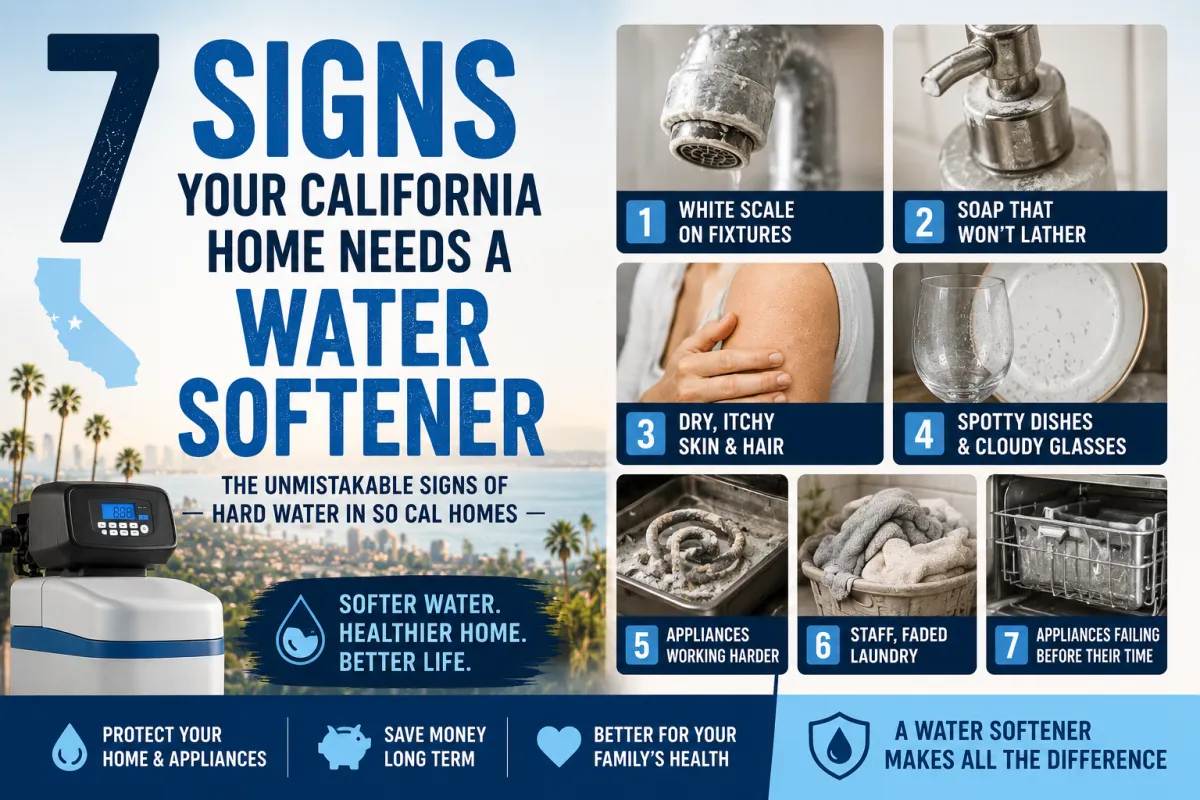
Everything Southern California homeowners need to know about hard water — what causes it, what it costs, and how to fix it. Pure Coast Water Co. covers the signs, symptoms, and solutions for hard water across San Diego, Temecula, Riverside, and beyond.
7 Signs Your California Home Needs a Water Softener
Hard Water · 6 min read
By Clinton Dye, Pure Coast Water Co.
Most Southern California homeowners don't wake up one day and decide they have a hard water problem. It sneaks up on you. A little white crust around the faucet. Dishes that never look quite clean. Skin that feels tight and dry no matter how much moisturizer you use. You chalk each one up to a different cause and move on.
But here's the thing: they're almost always the same cause. 85% of US households have hard water, where high levels of calcium and magnesium cause scale buildup and affect soap performance. In Southern California, that number is even higher. 17 of 25 major California cities have hard or very hard water above 7 GPG, with San Diego leading at 16.3 GPG. DropInBlogCulligan Escondido
If your home is showing any of the signs below, your water is almost certainly the culprit — and a whole-house water softener is the fix.
Sign 1: White, Chalky Buildup on Your Faucets and Fixtures
This is usually the first thing people notice, and it's the most unmistakable signal that your water is hard.
One of the earliest signs of hard water is white, chalky residue on faucets, showerheads, and sinks. This scale forms as minerals like calcium and magnesium accumulate on surfaces after water evaporates. Over time, buildup can clog fixtures and reduce water flow. DropInBlog
In San Diego, where water hardness averages 16.3 GPG, this scale can appear within days of cleaning a fixture. Wipe it down today and it's back by the weekend. That's not a cleaning product problem. That's a water problem.
The scale you see on the outside of your faucet is the same mineral deposit building up inside your pipes, your water heater, and every appliance connected to your water supply. What looks like a cosmetic issue is actually the visible warning sign of a much bigger problem happening out of sight.
Sign 2: Soap That Won't Lather — No Matter How Much You Use
Hard water and soap simply don't get along. If you've ever stood in the shower squeezing shampoo into your hand and wondering why it's not lathering, you've experienced this firsthand.
Hard water interferes with soap and detergent, making it harder to produce a rich lather. This often leads people to use more soap than necessary, increasing household expenses. Skin may feel less clean after washing, and hair can feel dull or heavy. DropInBlog
This isn't a product quality issue. Premium shampoo, cheap shampoo, body wash, hand soap — none of them perform properly in hard water. The minerals in your water are chemically reacting with the soap before it ever has a chance to do its job.
The result is that most Southern California homeowners use significantly more soap, shampoo, and cleaning products than they would with softened water, quietly adding to household costs month after month.
Sign 3: Dry, Itchy Skin and Dull, Brittle Hair
This is the sign that gets personal. If you or your family members are dealing with chronic dry skin, itchiness, or hair that looks dull and feels rough no matter what products you use, your water is likely to blame.
When you bathe and wash your hands with hard water, the mineral deposit buildup can cause your skin and hair to dry out, leaving you feeling itchy and flaky. Hard water also blocks up your pores and can cause skin inflammation, blackheads, and other blemishes. Santa Clara Valley Water
According to a study led by King's College London, hard water exposure has been linked to eczema in infants and children, with a similar study by UK Biobank finding comparable results for adults. The minerals in hard water affect the pH balance of your skin and can weaken the skin barrier that protects against harmful bacteria and infections. Purecitydata
For families with young children, this is especially important. If your child's skin is constantly irritated or they're prone to eczema flare-ups, the water they're bathing in every night could be making it significantly worse.
Sign 4: Spots and Cloudiness on Dishes and Glassware
If your glasses come out of the dishwasher looking foggy, spotted, or like they haven't been washed at all, hard water is almost certainly the reason.
Cloudy dishes and water spots on glassware are common complaints in homes with hard water. These spots form when mineral-rich water dries on surfaces, leaving behind residue. Even after repeated washing, dishes may appear dirty or streaked. DropInBlog
Hard water buildup can even make dishes more prone to chipping and breaking, leading to additional replacement costs. Santa Clara Valley Water
The frustrating part is that running the dishwasher again doesn't fix it. Using more detergent doesn't fix it. Switching dishwasher brands doesn't fix it. The only thing that fixes spotted, cloudy dishes is treating the water before it ever enters the machine.
Sign 5: Stiff, Faded Laundry That Wears Out Too Fast
Your washing machine uses a lot of water, which means it's also one of the biggest victims of hard water in your home. If your clothes feel rough and scratchy after washing, or your whites are starting to look grey and dingy, hard water is doing the damage.
Hard water prevents detergents from dissolving properly, leaving residue in fabrics. Clothes may feel stiff, look faded, or wear out faster than expected. Whites can appear dingy, while colors lose their vibrancy. DropInBlog
Clothes washed in hard water may fade more quickly and feel rough or scratchy to the touch because the minerals in hard water can be abrasive to fabrics. HighLevel
This means you're not just spending more on laundry detergent — you're replacing clothes, towels, and linens sooner than you should. Soft water is genuinely gentler on fabric, and most homeowners notice the difference in their laundry within the first few washes after installing a softener.
Sign 6: Low Water Pressure Throughout the House
This is the sign that most homeowners never connect to water quality, and it's one of the most expensive if left unaddressed.
Over time, your pipes can develop a buildup of mineral deposits from hard water. In extreme cases, this buildup can clog your pipes and slow water flow, leading to low water pressure. Purecitydata
Hard water can also cause scale buildup inside your water heater, restricting water flow, causing odd popping noises, and reducing the heater's efficiency — eventually causing the unit to fail entirely. HighLevel
In older San Diego homes, this process accelerates. Pipes that have been carrying hard water for years develop significant mineral restriction on the inside, reducing pressure at every fixture in the house. By the time most homeowners notice the pressure drop, the scale buildup is already substantial — and costly to address.
In homes with extremely hard water, the damage can be so severe that whole-house repiping is needed within 10 to 15 years, an expensive project costing anywhere from $5,000 to $15,000. Tappwater
Sign 7: Appliances Breaking Down Earlier Than They Should
This is the most expensive sign on the list, and the one most homeowners discover too late.
Mineral buildup inside appliances like water heaters, washing machines, and coffee makers reduces efficiency. Scale accumulation forces appliances to work harder, increasing energy consumption and wear. Over time, this can lead to breakdowns and costly replacements. DropInBlog
The numbers behind this are stark. 75% of water heaters fail by year 12 due to hard water damage, costing homeowners $1,500 to $3,000 to replace. Hard water costs the average homeowner $4,400 in appliance replacement costs, with utility costs rising 10 to 30% due to efficiency losses from scale buildup. Tapwaterdata
Your water heater, dishwasher, washing machine, and coffee maker are all quietly accumulating scale every single day. The damage is invisible until it isn't — and by then, you're shopping for a replacement appliance you shouldn't have needed yet.
Homes with softened water see up to 40% lower water heater operating costs, and tankless water heaters in hard water homes fail in just 1.6 years, while those with softened water last over a decade. Tappwater
How Many of These Signs Are You Seeing?
The more signs you recognize, the more urgently your home needs treatment. And in Southern California, where San Diego water hits 16.3 GPG and cities like Chula Vista measure TDS levels near 740 ppm, it's not a question of whether hard water is affecting your home. It's a question of how much damage has already been done.
The good news is that a whole-house water softener or salt-free water conditioner addresses all seven of these signs at the source. Within weeks of installation most homeowners notice:
Fixtures that stay clean longer
Soap that lathers properly again
Softer skin and more manageable hair
Cleaner dishes straight out of the dishwasher
Softer, brighter laundry
Better water pressure
Appliances running more efficiently
Pure Coast Water Co. offers free water testing for San Diego and Southern California homeowners. We'll tell you exactly how hard your water is, what contaminants are present, and what system makes the most sense for your home and budget, with no pressure and no surprise fees.
Call Pure Coast Water Co. today or click below to schedule your free water test.
Clinton Dye is a USMC Veteran and founder of Pure Coast Water Co., serving San Diego and Southern California with whole-house filtration, reverse osmosis, and water softening solutions.
